


ESSILOR EXPERTS AMBASSADOR
Essilor, a global leader in the production of ophthalmic lenses, has selected Mondelliani as "Experts Ambassador"
A recognition reserved for entities that combine optical expertise, service quality, and customer care. A confirmation of the work we carry out every day, for more than sixty years.
THE VIEW
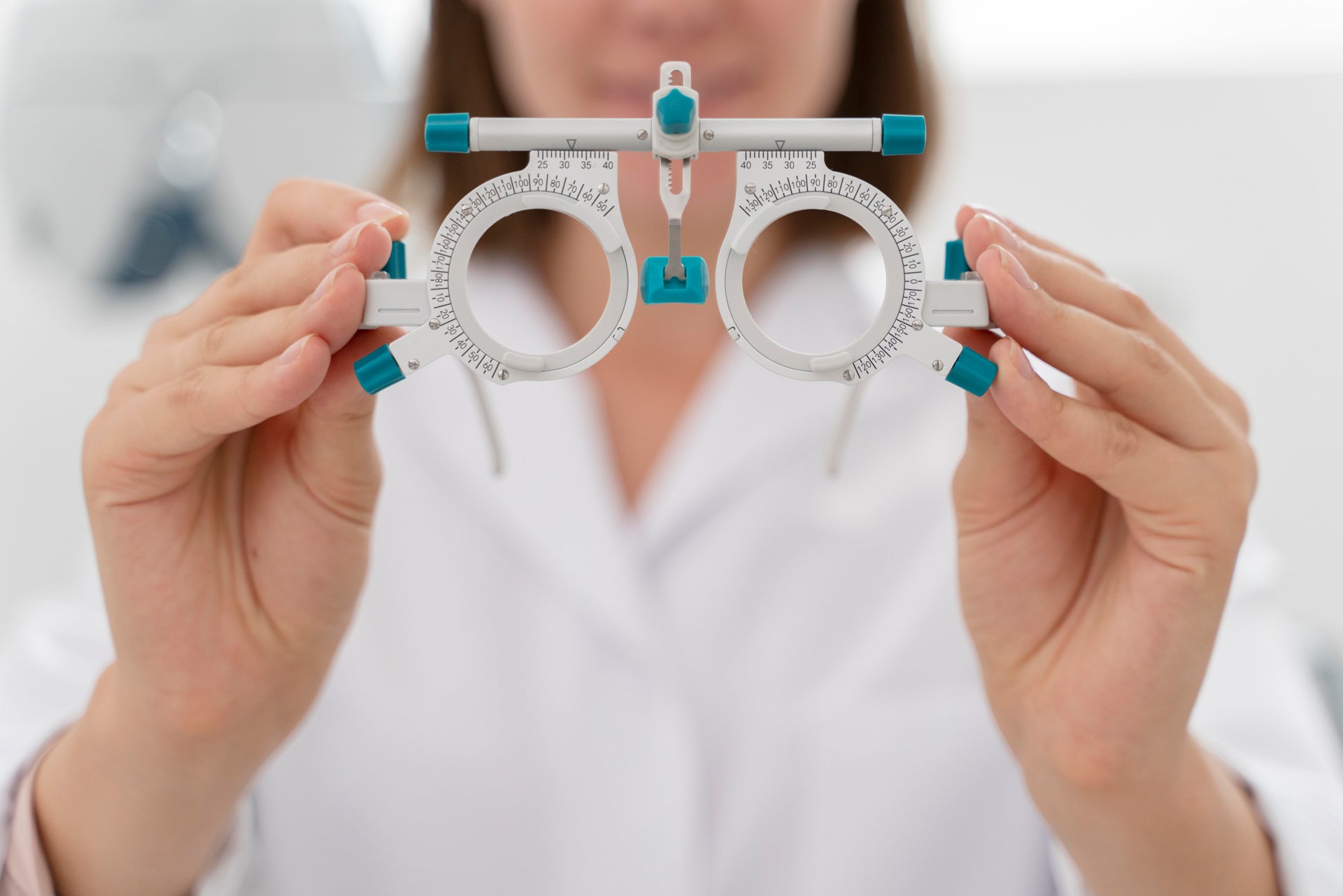
The creation of your next corrective glasses begins with the measurement of your vision.
In all our stores, our Optometrists are available to perform vision checks using state-of-the-art measuring tools and detailed vision screenings to find the prescription that best addresses your unique visual impairments.
We complete the vision measurement by identifying the Pupillary Distance, necessary for the correct positioning of the prescription lenses. This is used to "center" the focal point of the lens exactly at the center of the pupil and ensure greater visual comfort.
During our comprehensive examination, we also monitor intraocular pressure, the external state of the eye using a slit lamp to assess the application of contact lenses, and through the Cover Test, we evaluate ocular convergence to determine any deviations in the visual axes that could affect the adaptation to glasses.
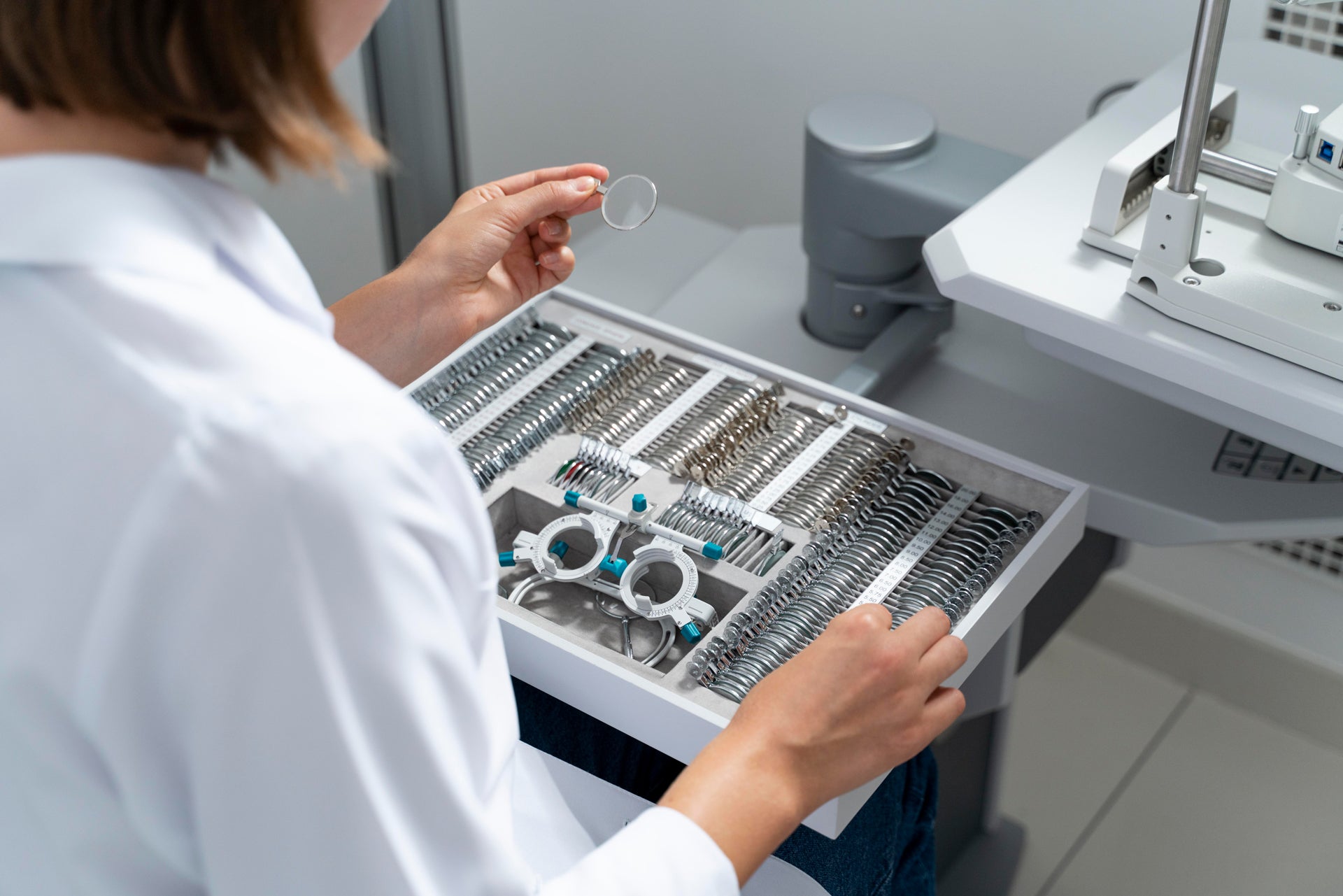
We perform vision measurements using cutting-edge tools, which ensure a lower risk in the creation of your corrective glasses, as well as minimizing hand contact with the eyes through the automation of lens changes with different prescriptions.
THE LENSES
We want to be a reliable reference point and a professional guarantee for our customers.
For this reason, we collaborate only with the best in the vision world to ensure highly personalized visual solutions, designed and created specifically to meet individual life and vision needs.
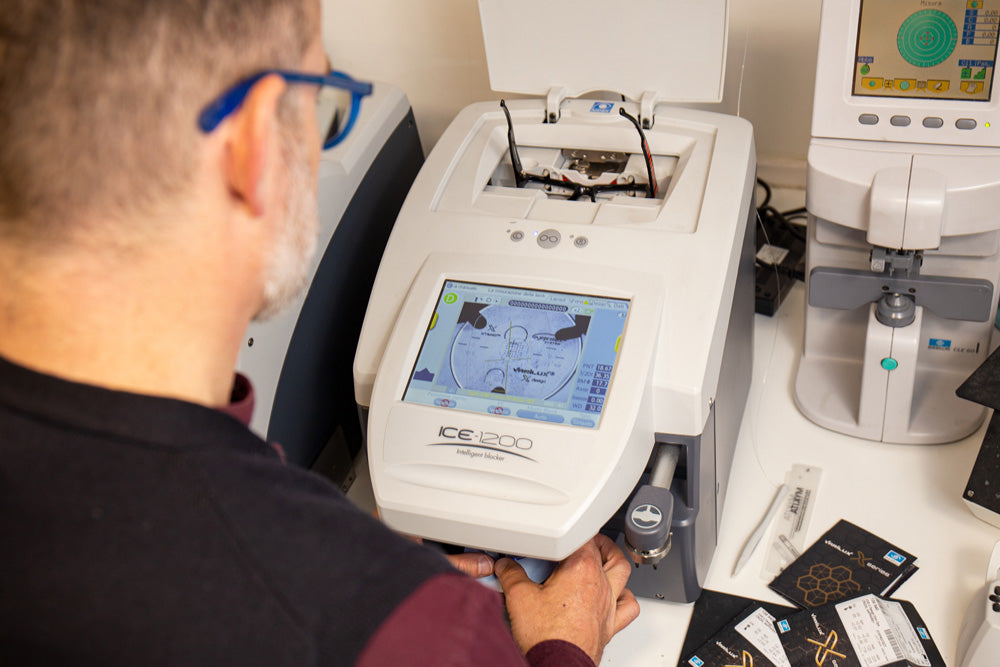
We choose innovative and technologically advanced lenses to correct vision, protect the eyes, and enhance visual clarity. All prescription lenses are finished and mounted in our laboratories located within our retail outlets, to be adapted to the shapes and sizes of the chosen frames.
We are recognized as an Essilor® Vision Specialist Center for our experience, passion, and commitment to visual well-being. We select Varilux® progressive lenses that ensure visual comfort at different distances and areas of vision, Eyezen® single vision lenses to reduce eye strain, especially when spending many hours in front of screens, and we rely on Transitions® photochromic lenses to provide protection in all lighting conditions.
For sun filters, we choose only the excellence of Zeiss lenses with internal anti-reflective coating, which protect against glare and 100% from UV rays.
For us, glasses must represent in a new and original way the lifestyle and identity of the wearer, which is why we also offer lens customization through sample coloring to make the chosen eyewear even more unique and personal.
THE CONSULTATION
We dream of revealing the beauty of the world with accessories like glasses, capable of lifting the veils from the surrounding world and being amplifiers of sensations and emotions.
That’s why we commit every day to helping people express their beauty, giving them character and creating a sense of belonging to a way of being that celebrates the beautiful and doesn’t take itself too seriously.
We offer a family-like environment while also ensuring professional standards. We respect the trust our clients place in us by listening to and responding to their needs and tastes.
The charm of a style with a story to tell, that doesn’t chase trends, characterized by a personal, ironic touch and full of color.
We love to surprise our clients in always new and original ways with proposals that reveal and express the lifestyle, identity, and beauty of those who wear them.

THE SHOWCASES
Our stores are all located in the center of Rome, landmarks for those who love the Mondelliani style.
Showcases that become a stage for artists, painters, or sculptors who, month after month, tell a story. Special places, with a personality that expresses itself in different forms while having a common root.
MONDELLIANI TIPS | To answer your most frequently asked questions
Do you know what the anti-reflective treatment of sunglasses and prescription lenses is and what it is used for?
The anti-reflective lenses capture reflections from every angle, helping to protect your eyes from UV rays and improving your clarity of vision.
BENEFITS:
- Superior Aesthetics.
- Greater transparency for better visibility of the eye from all angles.
- PURER VISION thanks to the reduction of reflections from every angle on one or both surfaces of the lens.
- High UV protection.
- Scratch protection.
- The lenses repel dust particles, ensuring clear vision and easy cleaning.
CRITICAL ISSUES:
- They can get dirty more easily: for this reason, the QUALITY of the anti-reflective coating is very important. The best anti-reflective treatments, like those we use at Mondelliani, also feature "anti-smudge" and anti-dust characteristics.
- They are sensitive to temperature fluctuations: for this reason, all anti-reflective lenses should be handled with greater care, and in any case, the best ones come with guarantees on treatments of at least 2 years.
At Mondelliani, we choose only quality lenses and over the years we have become partners with excellence such as Essilor, Hoya, and Seiko.
Is the multifocal lens the best solution for those who work a lot on the computer?
The multifocal lens is an excellent solution for those who use a tablet or laptop, while for those who use a traditional fixed screen, at eye level and at a distance of 70 cm, it may be less optimal.
BENEFITS:
- Quality of vision at every distance, using just one pair of glasses.
- Great, for example, while driving and for performing various activities throughout the day, often simultaneously, experiencing different viewing distances.
- With anti-reflective treatment and transitions technology, the eyes will be protected from UV rays and harmful blue light, both indoors and outdoors.
CRITICISMS:
- To see the screen clearly at 70 cm, one must raise their head too much, causing discomfort in the back of the neck. Therefore, it is recommended to use office lenses, to alternate with the multifocal glasses. Office lenses, also called dynamic lenses, cannot obviously replace multifocals but will be a valid support for prolonged work in front of the computer.
Do you ever feel like you have dry and red eyes, especially after a long day at work?
Every time we blink, that is, we close our eyelids, the tear film is evenly distributed to keep our eyes well-hydrated. However, some factors can disrupt this process, leading to dry eyes and redness.
MAIN FACTORS:
- ELECTRONIC DEVICES: when we are in front of a computer or smartphone, we tend to blink significantly less, and the tear evaporates much more easily. Brightness also forces us to exert more visual effort.
- AIR QUALITY: both indoors and outdoors, air that is too hot or too cold (perhaps windy) can cause tear evaporation and insufficient tearing.
- CONTACT LENS ABUSE: excessive use or unsuitable lens material.
- MEDICATIONS AND HORMONAL CAUSES: antihistamines, immunosuppressants, antacids, etc., can alter the composition of the tear film. The same applies to those who are in menopause, andropause, pregnancy, etc.
HOW TO COUNTERACT IT?
We at Mondelliani recommend first of all to have a thorough eye and/or contact lens examination to determine the cause. For daily life, we suggest some precautions:
- When using electronic devices, take breaks by looking away from the screen, blinking repeatedly for a few seconds, and keep the brightness low.
- In air-conditioned environments, avoid temperatures that are too hot or too cold. Outdoors, use sunglasses (when possible) to reduce direct contact with gusts of wind, dust, and strong brightness from the surrounding environment.
- For those who wear contact lenses, use a tear substitute as needed to moisten the eye and lenses. Do not exceed the hours of wear recommended by the optician/contact lens specialist.
- Those undergoing medication or experiencing hormonal fluctuations should discuss any eye discomforts with their doctor.
Why should those who use contact lenses not forget their prescription glasses?
Wearing contact lenses, even the most advanced ones, in addition to the comfort of good vision and the freedom of movement (for those who play sports, for example), alters a condition of naturalness that is that of the naked eye.
ERRORS AND DISORDERS CAUSED BY EXCESSIVE USE OF CONTACT LENSES
The latest generation lenses are designed to be extremely comfortable and gradually release moisturizers, which help keep the eyes hydrated.
However, all this may not be enough.
* The main mistakes that we all make are:
- wearing lenses for too many hours and/or sleeping with lenses on
- not using tear substitutes
- using lenses during seasonal allergies
- poor hygiene in maintenance
* Among the most common disorders we can find:
- conjunctivitis
- redness
- burning
- feeling of sand in the eyes
- alteration of tearing
- and other unpleasant sensations that can be easily avoided.
We at Mondelliani always suggest using, yes, contact lenses, but in moderation! The simplest solution is to alternate lenses with a good pair of glasses. This way, the hours of wearing lenses are reduced, significantly decreasing the most common discomforts, allowing our eyes to breathe independently again. Consequently, the natural processes of lubrication, nourishment, and cleaning that our body activates to keep our eyes healthy, giving us maximum visual comfort, are restored and maintained even when wearing contact lenses.
The idea of being able to wear comfortable, designer glasses, with the same quality of vision as lenses, if not better, and that allows one to feel at ease in everyday life, is definitely an added advantage for choosing to protect the health of one's eyes.
Does Presbyopia come for everyone? How to deal with it?
Presbyopia is a physiological condition that occurs in all of us; the important thing is to manage it well from the beginning to avoid it progressing incorrectly and faster than expected. If you are around 40-45 years old and notice that you see less well up close, thinking about setting the XL characters on your smartphone, don't worry, it's all normal; you are just starting to become presbyopic.
The glasses you find ready for reading start from +1.00, a prescription that is often too strong for those who need their first pair of glasses, while +0.75 or even +0.50 might be sufficient. Our advice is to use the right glasses right away, custom-made, to prevent irregular progression of presbyopia. “Custom-made” does not simply refer to the prescription, but means that when constructing the lenses, very important personal parameters such as the distance between the eyes are taken into account, and the reading distance of the wearer is evaluated.
When you read a sheet of paper or an email on your PC, your eyes are looking at two different distances and working in two different ways. It's like lifting weights in the gym, either 20 kg or 10 kg: your muscles exert more or less effort, and the same goes for your eyes; the closer you need to look, the more your muscles have to work. Your optician will be able to indicate the type of lens most suitable for the work you do and the use of the glasses you are purchasing.
How can the feeling of eye strain be alleviated?
One should not resign oneself to endure eye fatigue, as the ocular system is also made up of muscles and there are relaxation exercises worth knowing.
After ruling out visual defects and ocular motility problems with an eye and orthoptic examination, one can perform some simple eye relaxation exercises that can restore the pleasure of comfortable vision, even doing them daily at one's desk with a few minutes break.
- PALMING - Place your hands in a cupped shape and bring them over the eye area, one for each eye and without touching the eyelids, to create small areas of darkness. To benefit, maintain the position with your eyes closed for about a minute. Additionally, after rubbing your palms together until they are warm, gently apply them to your closed eyelids for about a minute. Repeat with pauses of a few seconds, trying to relax your mind as well, freeing it from thoughts.
- BLINKING - Blink your eyelids to help the eye improve its musculature and at the same time hydrate the eyeball. You can do this at any time and place: blink very quickly while keeping the eye relaxed for about 20 seconds, then rest for a few seconds before resuming. Repeat the cycle about 10 times in a row every day.
- SUNNING - Here, a light source is needed to relax the eyes. Sit in a comfortable but upright position, close your eyes, and gaze through your eyelids at the light source, ensuring it is not too bright or too close, causing discomfort. Then, slowly turn your head from side to side, keeping your eyes, behind the closed eyelids, fixed on the light source. Do this exercise for 3 minutes and then always proceed with palming.
OTHER USEFUL EXERCISES with an important constant: keep your head still.
- Move your eyes sideways: a very simple exercise that helps give our vision some relief. It involves fixing your gaze on a point and then, keeping your head still, moving your eyes as far right as possible and as far left as possible. You will see that by repeating this exercise several times, slowly, holding the position of the eyes for 5 seconds and breathing deeply, you will achieve relaxation of the ocular system and the rest of the body.
- Mentally perform, with your eyes, the infinity symbol, or "write" your name mentally with your eyes.
- Trace imaginary circles with your eyes in a clockwise and counterclockwise direction while keeping your head still.
Modern life demands a lot from our eyes. For example, when working on a computer, the eyes must adapt to different levels of contrast and brightness up to 30,000 times a day. The same happens when driving and exercising. It is not surprising, then, that our eyes suffer and begin to water, burn, and become red. This is often accompanied by tension in the neck muscles and headaches. However, one does not necessarily have to resign oneself to endure these disturbances. The ocular system is also made up of muscles, and as a result, it can become fatigued. Excessive stress on the visual organs increasingly undermines visual capabilities, promoting the onset of common problems such as burning and redness.
Is there a specific pair of glasses for computers?
There are occupational or "Office" lenses for specific use, at the computer and at the desk: they block blue light and allow for near and intermediate distance vision.
BENEFITS
The technology of an occupational lens allows you to read with a single pair of glasses and, by looking up, see the computer or the person in front of you without discomfort.
Additionally, anti-reflective treatments, along with blue light protection, help prevent eye redness and headaches. One pair of glasses to work safely at the desk without going crazy.
CRITICAL ISSUES
The world of occupational lenses is vast, and there are many types available.
Only a careful medical history and an assessment of personal needs can help choose the right lens for each of us.
Both anti-reflective treatments and blue light protection are guaranteed only by specific technologies, which are not visible but are present. Furthermore, aesthetics also play a role: our office lenses do not tend to yellow or gray like cheaper ones do.
What is the difference between an Eye Doctor and an Optician-Optometrist?
The ophthalmologist is a doctor and takes care of the health of your eyes.
The optician is a technician who measures vision and recommends the best lenses for correcting visual defects and maximizing the comfort of wearing glasses and contact lenses.
Of course, the ophthalmologist can also measure vision, but their main role is to prevent, identify, and treat all eye diseases.
Eye diseases refer to both those related to the outer part, such as conjunctivitis, corneal problems, chalazia, etc., and those concerning the inner part of the eye, such as the lens, vitreous humor, and retina.
The Optician-Optometrist measures vision daily and recommends the best corrective lenses for increasing visual comfort for patients.
They are the first to become aware of any problems and know why certain corrections or certain lenses are more comfortable than others. They are on the front line and receive compliments and complaints depending on their work (people rarely return to doctors to complain). We believe that everyone should focus on their own field. Beware of opticians who want to act as doctors, but on the other hand, also take with the right value the words of doctors who recommend a certain type of lens or drastically change the prescription of glasses without consulting your optician to verify the wearability of the suggested visual correction.
We at Mondelliani have been collaborating for years with the best ophthalmologists, working together to ensure that the health of our clients and the comfort of prescription glasses are always a top priority among the goals to achieve.
But can scratched glasses lenses be repaired?
Unfortunately no, prescription lenses correct visual defects thanks to their curvature. To eliminate scratches, the curvature would need to be changed, and thus the lens would lose its optical properties. Scratched lenses should be replaced. Nowadays, almost all lenses are made of plastic/organic materials. They are shatterproof and lighter than glass ones, but unfortunately, they are more prone to scratching.
Thanks to hardening and scratch-resistant treatments, they are definitely more durable than they were a few years ago; however, this does not mean you can just toss your glasses in your bag without protecting them with their case.
At Mondelliani, we always recommend lenses with top hardening and anti-reflective treatments, and many companies today offer insurance against scratches and accidents, so we can definitely say: “Scratch, I do not fear you!”.
But how do you clean the lenses of the glasses?
Let's clear the field of habits or misconceptions right away: you should not use saliva, dish soap, or other specific solvents. Just Marseille soap, or a specific spray, and a good microfiber cloth will do.
Washing your lenses should become a habit like washing your hands. Glasses get dirty just like anything else you wear during the day. Therefore, proper hygiene is desirable and necessary. You can safely wash them with Marseille soap, and after patting them dry with a towel, use the microfiber cloth to finish drying them.
At Mondelliani, we have adopted an eco-friendly spray for cleaning glasses. You can purchase it and come refill the bottle at one of our convenient dispensers, allowing you to reuse the bottles and avoid waste and harm to the environment.
Additionally, microfiber cloths should also be washed from time to time and replaced at least once a year. You know how much we care about our colorful microfibers!

