


Color blindness is one of the most common vision problems, especially among the male population.
It is a disorder that prevents the perception of certain colors of the spectrum, and in the most severe cases, it does not allow seeing any color.
There is still much to be done to find an effective remedy, but even today it is possible to adopt some solutions that at least help to alleviate the problem.
But let's see what it is and what the different types of color blindness are.
History and Definition of Color Blindness
In 1794, the English chemist John Dalton published an article discussing the incorrect perception of colors in some people, including himself. This article initiated the study of the condition that will be named color blindness after the author.

Scientifically known as dichromatopsia, color blindness manifests in different ways depending on which primary color is not perceived or is partially perceived by the affected individual.
In the case of total blindness to a color, we have:
- protanopia: red blindness;
- deuteranopia: green blindness;
- tritanopia: blue-yellow blindness.
In the case of partial blindness to one of these colors, we have:
- protanomaly: reduced sensitivity to red;
- deuteranomaly: reduced sensitivity to green;
- tritanomaly: reduced sensitivity to blue-yellow.
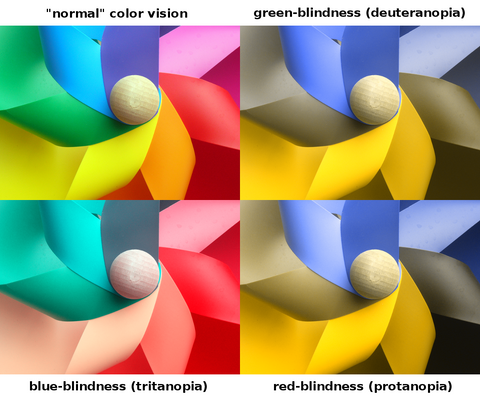
In the most severe form, called achromatopsia, none of the primary colors can be perceived and the world appears in black and white.
How Does Color Blindness Occur?
In most cases, color blindness has a genetic origin and results from a mutation of the X chromosome. Although, to a lesser extent, cases of color blindness induced by other conditions, trauma, or poor lifestyle choices can occur.
Men are affected much more than women, with an incidence of 8% in the total male population compared to 1% in the female population.
This is due to the fact that the genetic modification appears on the X chromosome. Since women have two X chromosomes, both must have this modification.
However, if the modification appears only on one of the two X chromosomes, the woman can be a “carrier” and pass color blindness to a male child.
Tests for Color Blindness
In 1917, Dr. Shinobu Ishihara, a specialist in ophthalmology, was tasked with developing tests to recognize color blindness. Thus, the “Ishihara Plates” were created, 38 cards that present disks containing numbers formed by dots of two contrasting colors. The numbers can be seen and recognized, depending on the test, only by those who suffer from color blindness or by those who have no visual defects.
In the case of preschool children, the test can still be performed, but instead of numbers, images are used.
Today, the test is used worldwide due to its ease and accuracy, especially in selections for those wishing to join the Army.

Diagnosis and Treatment of Color Blindness
As we have seen, diagnosis can occur at any age, even from a very young age. Unfortunately, there are currently no effective treatments, but it is possible to use some measures.
In particular, it is possible to use special lenses to which filters are applied that improve the contrast of images and somehow make it possible to perceive the difference in color.
Software and applications have also been developed that allow those who suffer from color blindness to “correct” images to make colors more distinguishable.
Do You Think You Are Color Blind?
On the internet, you will find many tests that will give you an idea of your color perception and will convince you whether or not you want to explore the case with a professional. So, for a diagnosis, consult your trusted ophthalmologist or schedule an appointment at our stores!

